



Cuisine d'Osaka Ryo
A restaurant that values its knives can make delicious things
As the number of restaurants that are particular about their ingredients increases, chefs too are becoming more selective about what kitchen knives they use to bring the most out of these ingredients. We believe that restaurants and chefs that carefully choose their knives and maintain them can make delicious food.
Our "Connecting with Taste: Chef Interviews" series is dedicated to introducing restaurants that create amazing cuisine through the charm of their chefs, greater than the sum of their parts which gourmet review websites cannot give justice to.
These places value technology, philosophy, tradition, and look at food from the perspective of not only themselves, but the kitchen knives they are wielding.
Our 15th volume takes us to Cuisine d'Osaka Ryo in Osaka's Nishi-Tenma area to speak with chef-owner Hatashima Ryō (畑島 亮). Hatashima is a qualified sommelier, and his restaurant is famous for fried skewers paired with wines and champagnes.
Read along, step into the inner side of these chefs, and enjoy their stories.
Table of Contents
- Family Time Memories of Taste
- Pushing Through Serious Training
- A Renewed Enjoyment for Cooking
- A Thirty Year Journey with Sakai Ichimonji Mitsuhide
- The Marriage of Exquisite Skewers and Alcohol
- Pairing Qualifications and Pairing Meals
- Restaurant Information
- Watch our Video Documentary
- Chef Hatashima's Favorite Kitchen Knives
Family Time Memories of Taste
Since Hatashima was a child, he's enjoyed eating delicious food and going out to eat with his family.
He belives his enjoyment of food might have been largely influenced by his parents. Despite his mother being a calligrapher, she said that she enjoyed cooking more than calligraphy, and Hatashima would often help her in the kitchen.
When considering his career path after high school, he learned about Tsuji Culinary School and approached that institution with high spirits.
Specialization still had to be considered, though. One of his seniors suggested "You should learn the basics of Japanese cuisine from the ground up." Following that advice, Hatashima started on the pathway of Japanese cuisine.
Pushing Through Serious Training
After graduation, Hatashima took up a job working at a restaurant in Minami-Osaka (southern Osaka). As a person with a competitive spirit, he and his strong-willed co-worker worked hard to outpace eachother during this time. Deep down, he was always fueled by the mindset of "I refuse to lose!" Yet, Hatashima was sure to mention with a laugh that his seniors were always very kind to him also.
After moving restaurants and continuing his training, his interactions with food increased beyond the sphere of Japanese ingredients, as not only did he mingle with chefs of Japanese cuisine, but Chinese and Western cuisines also.
Hatashima learned a lot from these cross-cultural interactions, such as proper usage of spices and fire techniques.
A Renewed Enjoyment for Cooking
Hatashima is part of the Osaka Cooking Association, where chefs gather to learn about Osaka's produce, and hone their cooking skills.
This association is frequented by many head chefs from famous restaurats throughout Osaka, so there is a lot to be learned every meeting, such as themes around the way of thinking about cuisine to focuses around efficiency without compromising flavor.
In Hatashima's case, he has recommended pairing Japanese food with oils and vinegars to match wines and champagnes, with a challenge of having his seniors say "What is this dish?" in excitement. Hatashima wants an existence where such exclamations can be said freely.
Now that Hatashima has established himself as a chef and worked very hard for a long time, he has rediscovered the fun behind cooking.
He cooks with the hope that Osaka's food scene will continue to get more exciting, while conveying what he was taught to future generations.
Note: The Osaka Cooking Association (大阪料理会) is a study group focused on Japanese cuisine, where cooks and chefs learn about ingredients and cooking methods with a distinct focus on Osaka. Kappo-style and other Osaka-inspired restaurants gather and exchange opinions and information through monthly presentations and tasting sessions.
The explanations above come from The Osaka Cooking Association's website, and you can find more information here (Japanese language only.)
A Thirty Year Journey with Sakai Ichimonji Mitsuhide
At the restaurant where he apprenticed, every knife in the kitchen was one from Sakai Ichimonji Mitsuhide. This influence naturally led him to adopt the brand for his own tools. Today, he owns a complete collection of their essentials, including honekiri, yanagiba, and gyuto knives.
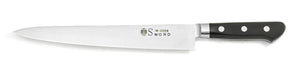
The Yanagiba he currently uses is a Kirameki White Steel #1 Akaro Yanagiba , the knife he fell in love with at first sight at the Osaka store.
That knife in particular feels very familiar in his hands, and he enjoys the kireaji (cutting ability) of this knife above all others.
It's been thirty years since our knives first entered Hatashima's hands. Even now, whenever Hatashima needs to go to the Dōguyasuji Shopping District, he makes certain to visit our store to say hello.
The Marriage of Exquisite Skewers and Alcohol
Hatashima is currently working towards making a fried skewer with a fluffy and crispy texture.
The frying oil is a blend of lard and tallow with canola oil and slightly seasoned vegetables.
The batter is made by mixing egg yolks, beer, and milk with high-gluten bread flour, adding a seperate egg white to create a light texture. But, Hatashima reminds us that this recipe isn't set in stone and may change.
While studying everyday, he exchanges many opinions.
"Let's try that this year." "Isn't this more suitable with this alcohol?"
Questions like that shape what Hatashima does little by little.
Fried skewers wrapped in sautéed porcini mushrooms are particularly popular at his restaurant, as they pair well with champange and white wine.
Pairing Qualifications and Pairing Meals
Hatashima believes that the compatibility between fried skewers and champagne is so high that there is basically no poor combinations.
As Hatashima was also interested in the world of alcohol, he obtained a sommelier qualifiction. Having a great drink with a meal makes the whole dining experience twice as enjoyable.
Alcohol has many variations too, such as Chardonnay made only with white grapes, and richer types of champagne made with black grapes.
The role of a sommelier is not only to serve drinks like champagne and wine, but to also suggest drinks according to the customer's preferences and dishes. To that end, sometimes he'll recommend sake or cocktails instead if the situation calls for it.
Just as there are various ways to drink sake, such as at hot or cold temperatures, Hatashima would be happy if champagne could also be enjoyed freely.
The theme of Hatashima's life over anything else is "fun." He hopes he can provide that theme to his diners now and in the future.
Restaurant Information
Cuisine d'Osaka Ryo
https://cuisine-d-osaka-ryo.com/
Shoei Building 1F, 4–2–7 Nishitenma, Kita Ward, Osaka
06–6364–1194
Trading Hours
Lunch 11:30–16:30 (11:30 AM–4:30 PM)
Dinner 17:30–23:00 (5:30 PM–8 PM)
Closed Mondays
Watch our Video Documentary
Our Japanese YouTube team has filmed a mini video documentary on Hatashima and Cuisine d'Osaka Ryo. Enjoy the video below.
Please note it only officially has Japanese audio and subtitles, but automatic translations are available. Nuance and meaning may be lost though, so please refer back to the original Japanese as fact over any translations.
Chef Hatashima's Recommended Kitchen Knives
Chef Hatashima has used our knives for over thirty years! Here's some of his favorites.
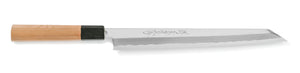
Kirameki White Steel #1 Yanagiba with Akaro Handle and Mirror Finish
We reserve the Kirameki branding for our most premium knives, and this yanagiba is no exception. Made of White Steel #1 by hand in Sakai, this knife is designed to last for decades if properly used and cared for.
Using an akaro or red-urushi lacquered handle, this mirror-finished yanagiba has had extra polishing work around the chin and spine of the blade, making this knife incredibly comfortable to use and popular in professional settings where presentation cooking is important.
Yanagiba knives themselves are the most important knife in the world of sashimi, as that is precisely what this knife is designed to do. A well-made yanagiba prevents cellular breakdown of sashimi when it is cut, retaining mouthfeel, nutrients, and taste.
If you make sashimi professionally or want to improve your sushi-making ability, this knife is top of the class.
Note: We do sell a White Steel #2 Mizu-Honyaki version of this item as well - contact us directly if you are interested!
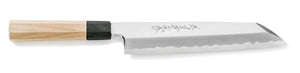
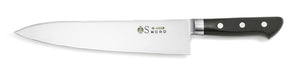
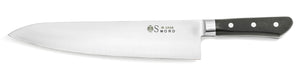
Sakai Ichimonji Mitsuhide VG-1 G-LINE Gyuto w/ Granton Edge
Our G-LINE knives have been trusted by chefs in Japan for decades, known as being reliable and sturdy with good edge retention.
VG-1 stainless steel has existed for a very long time, and these days is known for being one of the best steels for cost performance. While it does have less rust resistance than other stainless steels, for edge retention it is one of the best out there, making it very popular in restaurants who have chefs that work for long hours.
The Granton Edge ferruling on the sidd helps reduce contact between the food and the knife, reducing the amount of food that sticks to the blade.
Used by chefs in Japan and the rest of the world, this gyuto chef's knife is one of our mainstay products.
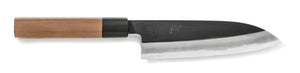
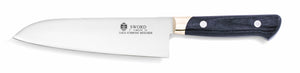
Sakai Ichimonji Mitsuhide VG-10 Gyuto with Western-Style Ebony Handle
This VG-10 gyuto is a higher-end version of the G-LINE gyuto above, with a wooden handle and nickel silver bolster and butt.
For chefs who want the functionality of a Western-style knife and handle, but still value the wooden handle Japanese-style knives are known for, this is a reliable choice.
VG-10 has better rust resistance than VG-1, and thanks to its introduction of cobalt performs a little better in general. It blunts slightly faster, but is significantly easier to resharpen as a result.
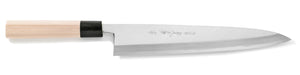
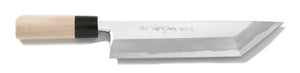
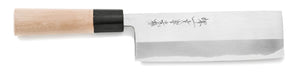
Sakai Ichimonji Mitsuhide White Steel #2 Kasumi Hamokiri
Our White Steel #2 Kasumi hamokiri knife has great cost performance, and a wonderful hazy-like appearance. This knife is designed to smoothly cut through conger pike eel (hamo), a popular fish in the Kansai region closely tied to Osaka and Kyoto based cuisine.
The long, thick, single-edged blade is designed to cut through the small bones hamo is known for having. If you listen closely as you cut, you'll even hear the heavy blade make a crushing sound as it works through the eel.
The handle is made of water-buffalo capped Japanese magnolia wood (hō), which is cost efficient, yet protects against water damage well. Light at first, the wood naturally darks overtime as it is used and conforms to the user's hands.
Please keep in mind as a single-edged knife, this is designed for right-handed use. Contact us if you are looking for a left-handed hamokiri.