

Fixing A Broken Knife Tip
Don't panic if your kitchen knife has a broken tip! The tip is the thinnest part of the kitchen knife, and this can happen. Even professional knives using them carefully can, and sometimes do run into this situation. Infact, it's the most common style of repair we see from customer requests in our store.
While it is unfortunate, and you should stop using the knife if that happens, this can be fixed. With a little work, you can bring the knife back to a functional condition and have it ready for your next cutting session.
This article will teach you how to restore your kitchen knife's tip if it has been chipped off, and present you four different methods to do this. All you'll need is a whetstone!
These tips come from Watanabe Jun, one of our sharpening leads who has 20 years of experience at Sakai Ichimonji Mitsuhide.
Method One: Grinding The Cutting Edge
Method One is perhaps what you would expect to do to fix a chip, and that is sharpening the chip away by sharpening the cutting edge. This method is pretty similar to putting on a micro-bevel, just sharpening right at the edge until you work through the chip and reshape the knife.
However, this is the method we actually recommend the least.
Working a knife this way can cause the curve in the knife to change abruptly near the tip, leaving a shape that is awkward to use.
This is fixable by resharpening and reshaping the entire belly, but this takes a large amount of time, effort, and material.
This is a valid approach, and is one that many people do - but if you are interested in making your knife last as long as possible while restoring it, we do not recommend this approach in most cases.
Method Two: Grinding The Spine
Method Two takes an inverse approach compared to Method One, where instead of grinding your edge aganist the whetstone to reshape the knife, you grind the spine instead. We believe that this method is the most practical approach to fixing a chipped knife tip.
The biggest advantage here is that your edge is left alone, so no edge resharpening or refacing is required. However, this method does not work in all situations.
This method isn't suited to larger chips. If your chip is over 1 centimeter long, sharpening via this method will cause the spine to curve sharply, making your knife look a little more like a sickle in some situations, drastically changing how it needs to be used.
This method also is most destructive to your whetstone. Sharpening via this method involves grinding the very back of your knife against the stone multiple times to wear steel away, which will also cause your whetstone to noticable dip. Some people use the side of their whetstone instead when using this approach, but eventually when you hit that part of the whetstone it will be somewhat compromised.
Expect to flatten your stone considerably after using this approach.
Method Three: Grinding Both Sides
Our favorite approach is a combination of Methods One and Two, where you remove a knife tip by sharpening both the edge and the spine of the knife equally.
As the work is shared between both sides, the knife's overall shape becomes less warped, and you wind up with a cleaner result more akin to the knife's original shape.
There are some special rules to sharpening with this method. If you grind only at the tip, you'll run into the curved belly issue we mentioned earlier, so you need to start sharpening further down the belly of the knife, roughly right where the belly begins to curve. If you do this correctly and make sure that you are taking off steel equally across the belly while also grinding the spine, you'll fix the chip but also keep a fairly clean knife shape.
The tradeoff with this method is that it takes the longest amount of time, and the most amount of effort. If you are aiming to really care for your knife and have it last as long as possible while retaining its original functionality though, this is the method we recommend the most. We feel it is worth the effort, especially if it's a knife you really care about!
Method Four: Kiritsuke Conversion
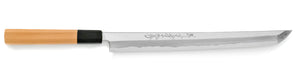
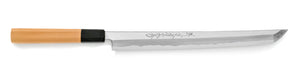
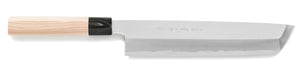
Method Four is more of a shortcut, as it involves changing the knife completely. In this situation, you modify the knife tip completely and change your knife into a kiritsuke-style knife. This is the fastest and simplest method, but changes your knife completely.
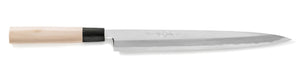
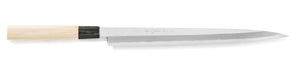
For some knives with slimmer or more narrow blade or tips like yanagiba and petty knives this method can work well, but it something that is not easily reversed.
Kiritsuke-shaped knives tend to cut a little differently - feel free to watch our YouTube video on this subject if you'd like to learn more!
Which Method Is Best, Plus Extra Tips
Each method above has its own merits and demerits, making them all good for different situations. Most of this comes down to how bad the chip is on your knife's tip.
If the chip is a few millimeters long, we recommend using Method Two. This is the fastest, most practicaly, and won't warp your knife's shape too much.
If the chip is 1 centimeter of above, we recommend using Method One, Three, or Four. In any case, you will really need to reshape your knife, and method two will create a bit too much of a sickle-shape at the tip itself. Method Three is our recommendation, but Method One takes less time. Method Four is also very fast, but changes your knife greatly and is destructive - once you go that way, you can't really take it back.
At the end of the day though, if you want the cleanest possible result, while we would recommend Method Three, you should try Methods One and Two as well to find which is best for you! Everyone sharpens a little differently, and your experiences may vary. Our recommendations are based on our own experiences, which will be different to yours.
A very important extra tip is put marker on the areas you want to sharpen before you start sharpening, using something like a red marker that stands out but is still somewhat seethrough. This will prevent you from accidentally oversharpening your knife, saving you from accidentally having to do extra unnecessary work.
Our Sharpening Services
While the above contains many tips to sharpen your kitchen knife and repair it, we understand that it can still be quite daunting, especially if the knife has sentimental value.
In these cases, we do offer sharpening services in our store. Almost all of our knives come with a complimentary sharpening ticket with no expiry, valid for one use (extra fees do apply for large chips, though.)
Feel free to contact us whether the knife is from our brand or not, and we'll be able to help you. You can mail the knife to us, or bring it in during your next Japan trip!
Watch Our YouTube Video
If you want to see some more visual examples of the techniques we are talking about, please watch the YouTube video we've also made covering this topic.
Please subscribe to the channel as well to get new videos about kitchen kninfe culture and maintenance!
Frequently Asked Questions
Find the most commonly asked questions to us about knife tip restoration here, and feel free to contact us if you have other questions!
Is my kitchen knife useless if the tip is chipped?
You should stop using your kitchen knife if it has a chipped tip, but it is not useless. With a bit of effort, or by taking it to a professional, your kitchen knife can be saved.
What's the fastest way to fix a kitchen knife tip?
The fastest way to fix a kitchen knife tip would be by converting your knife into a kiritsuke-style knife, but this is very destructive.
For small chips, we would recommend grinding away the spine, but for larger chips there is no real fast method, bar changing your knife into a kiritsuke-style knife.
How does a kitchen knife tip chip?
The tip of a kitchen knife is the thinnest part of it, and even through regular usage sometimes chips can happen accidentally.
You can avoid chips somewhat by using the right kind of cutting board, and being careful with your cutting technique. Sometimes though chips will still happen, and it may not be your fault! Message us if your knife chips, or follow our article above and try to fix it at home.
Do I need special whetstones to repair chipped tips?
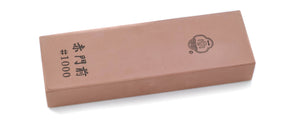
You do want to make sure your whetstone is one that you would use for regular Japanese kitchen knife sharpening, but it needs to be one that is not too fine. In our article here, we have used a #1000 Akamonzen Medium Stone and feel it is suitable for this task, but every situation is different.
Contact us if you need specialised advice.
The chip is really large on my kitchen knife, should I be worried?
If the chip is larger than 2 centimeters, it is best to contact someone like us first as that is a very large amount of repair work.
Alternatively, consider converting your knife into a kiritsuke-style knife.