


JAZZ BERRY
A restaurant that values its knives can make delicious things
As the number of restaurants that are particular about their ingredients increases, chefs too are becoming more selective about what kitchen knives they use to bring the most out of these ingredients. We believe that restaurants and chefs that carefully choose their knives and maintain them can make delicious food.
Our "Connecting with Taste: Chef Interviews" series is dedicated to introducing restaurants that create amazing cuisine through the charm of their chefs, greater than the sum of their parts which gourmet review websites cannot give justice to.
These places value technology, philosophy, tradition, and look at food from the perspective of not only themselves, but the kitchen knives they are wielding.
Our 14th volume takes us to JAZZ BERRY in Osaka's Kita-Horie area to speak with chef-owner Maeda Kōhei (前田 耕平). Maeda has expanded from one business out to three, allowing him to have multiple ways to express his cuisine. For this article though, we will focus on his liveliest restaurant yet.
Read along, step into the inner side of these chefs, and enjoy their stories.
Table of Contents
- The Delicious Memories of Childhood
- Knowledge From Every Experience
- Independence and Expansion: Pandemic-Triggered Ambition
- The Red Tents of JAZZ BERRY
- Tool Maintenance Equals Work Fundamentals
- Kireaji Determines Taste
- Team Building Brings "Plus Alpha" To Deliciousness
- Conversation Creates Excellence
- Embrace the "Spice of the Times"
- Restaurants Can Bring More Value Than Food
- Restaurant Information
- Watch Our Video Documentary
- Chef Maeda's Recommended Kitchen Knives
The Delicious Memories of Childhood
Maeda is originally from Osaka. He tells us it's due to his mother that he chased the dream of becoming a chef; from a child she told him to become one! As the youngest of three, he was often helping with the home cooking, but at the same time never found it too difficult.
His parents also really enjoyed food, which meant Maeda went out to eat a lot. His grandmother used to make vinegared dishes for him with high quality mackerel. Looking back, he realizes he was given wonderfully good food from a young age.
This might have given him a stronger desire of delicious food compared to most people.
Knowledge From Every Experience
Maeda originally studied engineering and went to work in a factory, but found that factory life didn't fit him at all. As someone that enjoys conversation, he decided to work part-time in an izakaya kitchen, enjoying the job so much that he stayed working there for a while.
Because an izakaya is a place anyone can easily drop by, he enjoys meeting all kinds of people there. As he was looking to start his own business, starting an izakaya was firmly in his mind.
At the time, Maeda happened to visit an izakaya for a drink, and it turned out to perfectly fit his ideals. He wanted to work there, so he took a risk by going in with just a resume and no appointment. Luckily for him, he was hired.
That said, when he started working there he found the rules to be extremely strict. This rigidity allowed him to properly learn the processes of running an izakaya restaurant. After that, he moved on after his career there to working at the Osaka Central Wholesale Market at a fish shop. Not only did he learn about fish, but he also learned about "business", which has had a major influence on his management today.
He gained extra experience working with Michelin Star-level restaurants also.
By working at both low-end and high-end restaurants and fish outlets, he was able to carefully consider what kind of store he would open, including its scale, price range, type, and timing, which has directly influenced where he is today.
Independence and Expansion: Pandemic-Triggered Ambition
Maeda's first store was a small independent shop in Namba, around seven tsubo large (1 tsubo is 3.3 square meters). This store capacity eventually became insufficient, leading to the store moving to its current location in Shinsaibashi.
However, Maeda's growth did not stop here. Other stores expanded from this Shinsaibashi base, with this growth triggered by the coronavirus pandemic. This pandemic brought with it numerous restrictions, creating a situation where his staff were unable to work.
Maeda still had to pay their salaries though, so he decided instead to take a risk and open a second store his remaining staff could work at, attacking the restrictions directly with ambition.
The Red Tents of JAZZ BERRY
Maeda's third store "JAZZ BERRY" is marked by the terrace seats under red canopy tents. Because he loves music, a piano was also installed at this store. He hopes customers can enjoy live music while dining.
Thanks to his strong connections at the Osaka Central Wholesale Market, he is able to get high-quality fish that haven’t been bought by others at discounted prices. This directly converts to reasonable prices for customers, and is one of his greatest strengths.
While he is, of course, confident in his fish and recommends trying the sashimi, the egg sandwich and fish and chips are also highly recommended.
Tool Maintenance Equals Work Fundamentals
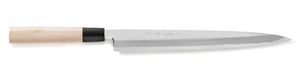
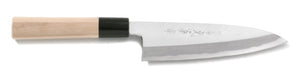
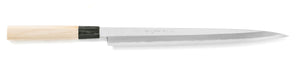
Maeda uses a yanagiba and deba from Sakai Ichimonji Mitsuhide. He started using our knives after finding us on Doguyasuji Shopping Street and purchasing one there, taking advice in terms of steel and knife length from the sales staff at the time.
While this may be an older concept, Maeda believes that a child that can take care of their tools and handle them carefully will do a good job. On the contrary, one that cannot might have more difficult to complement skills in the workplace.
To Maeda, the maintenance of his tools is a core fundamental of his work ethic, so he always tries to be aware of his own thoughts.
Kireaji Determines Taste
For fish, it is important to quickly process the internal organs and scales, Maeda says. If you use a kitchen knife that can't cut well, your speed slows down and the body of the fish gets crushed.
Also, if you cannot cut sashimi smoothly in one cut, the texture of the fish will be bad. When a customer puts a badly textured piece of fish into their mouth, how are they going to chew and swallow it?
Maeda cuts his sashimi quite thickly, paying attention to the cutting method applied so that the flavor of the fish is maximized.
Team Building Brings "Plus Alpha" To Deliciousness
In the food business, deliciousness is taken for granted. However, Maeda thinks owners and chefs can do a little more to improve the atmopshere. Japanese has a loanword term for this - purasu arufa or more simply, plus alpha or +α.
Maeda doesn't think that owning a restaurant is about simply making food patrons can enjoy, and he often tells this to his staff. There is no financial cost to talk to people, he believes. Customer service and care are the same, and should be treated as important.
Maeda aims for a service that asks "Why don't you take one bite of this freshly made food?" with a understanding of wondering what he himself would be happy about if he was a customer.
Discovering and focusing on this is important, and Maeda belies the education of staff should never be neglected. As one person he is limited, but if he has ten staff members with similar beliefs, what they can all do as a team increases significantly.
Conversation Creates Excellence
Maeda often talks to his staff about the management of the store. This isn't limited by employment type, gender, or age. He values the opinions of all his team.
At first, his employees might wonder why he talks about management to them, but they gradually start thinking from the owner's perspective, considering how they can encourage customers to return.
Maeda always tells his staff to take actions that would make him and customers say, ‘Alright, let’s go with that’.
For example, when recommending a menu item to customers, they need to present the dish in a way that highlights its appeal and encourage customer to say "Alright, let’s go with that."
The same goes for their work. If they notice a problem, they need to think of a way to improve it and make a proposal, encouraging Maeda to say, “Alright, let’s go with that.”
He gives authority equally to both full-time and part-time staff, encouraging them to work responsibly and actively raising the wages of the staff who take this to heart.
Embrace the "Spice of the Times"
All restaurants face a common problem, the impact of high food costs. If the cost of producing a dish goes up, naturally the selling price of the dish also goes up. In that case, customers who are used to coming at the previous price may find it harder to visit.
But when Maeda thinks about how to tackle this problem, his options are limited. He can either increase the unit price and compensate by providing better food and services, or actively change his brand to start targeting inbound customers, such as overseas tourists visiting Japan.
This problem exceeds the hospitality sector; if you don't embrace the ‘spice of the times’ as Maeda calls it, store management can collapse.
In the past, no one trusted online reservations, thinking they would just get canceled at the last minute. But now, they have become mainstream. What he considers the ‘spice of the times’ is the ability to adapt flexibly to such changes.
More Than Just a Meal
Maeda believes that dining at a restaurant will increasingly be seen as a "luxury experience", including having a meal while listening to live music at JAZZ BERRY.
"Luxury" refers to something that is not essential. People can cook and eat at home, so what makes people choose to dine out?
Maeda ponders on these questions, while continuing to think about how much value he can provide at his establishments, and then act on it.
Restaurant Information
JAZZ BERRY
https://osaka-maedaya.com/jazz-berry/
102 Belvogue Kitahorie, 1-9-18 Kitahorie, Nishi Ward, Osaka
090-7754-0003
Trading Hours
12:00~23:00 (12PM~11PM)
Open Daily (holiday operations may vary)
Pets OK in outdoors terrace seating
Note: JAZZ BERRY also has online reservations, and supports group bookings of over 5 people. JAZZ BERRY also supports catering bookings of over 30 people.
Watch Our Video Documentary
Our Japanese YouTube team also filmed a mini video documentary on Chef Maeda and JAZZ BERRY. Enjoy the video below!
Please note it only officially has Japanese audio and subtitles, but automatic translations are available. Nuance and meaning may be lost though, so please refer back to the original Japanese as fact over any translations.
Chef Maeda's Recommended Kitchen Knives
Ever since Chef Maeda found us in Doguyasuji, he has been using Sakai Ichimonji Mitsuhide knives in his fish preparation. Have a quick look at some of his favorite knives from us below.
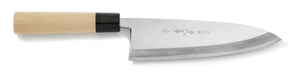
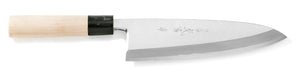
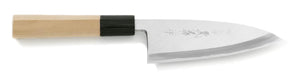
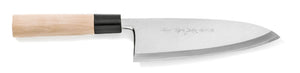
Sakai Ichimonji White Steel #2 Tan Kasumi Deba
A staple knife from us used by many chefs around Japan (including multiple chefs in our Meet The Chefs series), our White Steel #2 Tan Kasumi Deba is the essence of cost performance.
Carbon steel knives cost less, and perform very well, but require more maintenance and can have other concerns, such as edge retention. Our Tan series is forged at a lower temperature, creating more durable structure.
This means you get the power and performance of White Steel, without the downside of lesser edge retention. For professionals, it is a great daily driver knife.
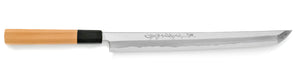
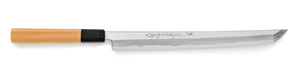
Sakai Ichimonji Mitsuhide White Steel #1 Montanren Sakimaru Takohiki
Our Montanren series is some of the best traditional knives we offer, using White Steel #1 as the cutting steel supplemented with a hexagonal yew wood (ichi-i) handle. The wavy pattern or montan on the back is a sight to behold, and a pattern that can only be truly developed by the finest of artisans, many of which are in Sakai, Osaka.
Sakimaru Takohiki are thinner sashimi knives, primarily designed for cutting octopus or tako, but can also handle many kinds of sashimi as well. Great for those who want a lighter knife, or are looking to make a more precise cut.
The sword-like tip also looks amazing, so this is a wonderful presentation piece.